Let’s talk about overbites. While many people see them as just a cosmetic issue, they can also affect how your teeth align, how you chew, and even how your jaw feels day to day. If you’ve ever wondered, “Is an overbite bad?” you’re not alone.
Some signs are obvious, while others are easy to miss. And we are here to help you get the facts and the smile you deserve.
To bring you the most accurate insight, we also spoke with
Dr. Mike
, a practising dentist, who shared his thoughts on how overbite correction can improve both the look and function of your smile.
Quick Check: Do You Have an Overbite or an Overjet?
It is incredibly common to hear people mix up overbite and overjet, but they actually describe two completely different directions of teeth misalignment. To figure out the right fix for your smile, it helps to know exactly which way your teeth are traveling:
Overbite (The Up-and-Down Overlap): Think of this as a vertical issue. It measures how far your top front teeth drop down over your bottom teeth. If your top teeth completely hide more than a third of your lower teeth when you bite down naturally, you have what dentists call a deep overbite.
Overjet (The Front-to-Back Gap): Think of this as a horizontal issue. It measures how far your top front teeth stick forward past your bottom teeth. This outward gap is what people are usually talking about when they use the phrase "buck teeth."
The 2-Second Mirror Test
Look from the front: If your bottom teeth are completely hidden when you smile, you might have a deep overbite.
Look from the side profile: If your top teeth jut forward away from the lower jaw leaving a distinct gap, you might have an overjet.
Understanding Overbite: What It Is and How It Looks
So, what exactly is an overbite? It is when your upper front teeth stick out too far over your lower teeth. A little bit of overlap is totally normal. In fact, most people have some. But when the top teeth cover too much of the bottom ones, that is when it becomes something to pay attention to.
If you are wondering what it actually looks like, imagine smiling and noticing that your top teeth hide most of the bottom ones. That is called a deep bite, which is a type of overbite. A normal bite, on the other hand, has a slight, natural overlap that does not block your bottom teeth from view.
You might also hear the term Class 2 Overbite floating around. This is just a way dentists describe a more noticeable overbite, where the upper jaw is positioned quite a bit ahead of the lower jaw.
What Causes an Overbite?
An overbite usually stems from a mix of your DNA and early childhood habits. To make it simple, dentists break them down into two types: skeletal overbites (caused by bone structure) and dental overbites (caused by tooth alignment).
Some common causes include:
Genetic Jaw Imbalance (Skeletal): Your jaw shape or tooth size might run in the family. If you inherit a lower jaw that grows a bit slower or is naturally smaller than your upper jaw, your top teeth will automatically overlap the bottom ones when you close your mouth.
Prolonged Thumb Sucking (Dental): Thumb-sucking is totally normal for toddlers, but if it keeps going past age 3 or 4, it becomes an issue. That constant upward pressure actually reshapes the roof of the mouth, altering how the front and back teeth meet and paving the way for a deep vertical overbite.
Chronic Mouth Breathing: This one surprises a lot of people. When a child constantly breathes through their mouth (usually due to allergies or stuffed up adenoids), their tongue rests on the floor of the mouth instead of the roof. Without the tongue providing that natural internal support, the upper jaw narrows and the lower jaw drops back and down, throwing off the bite's vertical growth.
Tongue thrusting or atypical swallowing: Every time you swallow, your tongue is supposed to press upward against the roof of your mouth. With tongue thrusting, it pushes forward against your front teeth instead. That continuous, repetitive nudging alters how the front teeth come together, preventing them from aligning correctly.
Missing or Impacted Lower Teeth: Think of your back teeth as pillars holding up a roof. If a few lower back teeth are missing or never fully grow in, that support collapses. When you bite down, your lower jaw shifts slightly too far upward, causing your top front teeth to drop down and completely hide the bottom ones.
Most overbites start developing in childhood, which is why early habits matter. But just because it starts young does not mean adults are off the hook. An untreated overbite can continue to shift over time. And yes, it can still affect you as an adult.
A normal bite consists of a minor vertical overlap of 1 to 3 mm. An overbite becomes symptomatic when the overlap exceeds 4 mm or 30% of the lower teeth.
Visual Symptoms
Noticeable overlap: One of the clearest signs of an overbite is when your upper front teeth sit too far over your lower front teeth. A little overlap (usually 1 to 2 millimeters) is totally normal. But when your top teeth cover more than one-third of your bottom teeth, especially when you bite down, that is often a red flag. This can make your teeth look “tucked in,” and in photos, it might look like your lower teeth are barely there. Some people also feel like their chin is pushed back a bit or that their smile looks slightly unbalanced.
Lips not closing naturally: Do your lips feel like they have to work to stay shut? That gentle lip seal when you are at rest should feel relaxed, no effort needed. But if your overbite is more severe, your upper teeth might push your lips forward just enough to make closing them feel strained or unnatural. Over time, this can even lead to dry lips, mouth breathing, or changes in your face’s resting posture, especially noticeable in kids as their facial features develop.
Functional & Physical Symptoms
Jaw pain or clicking: When your bite is off, your jaw joint (called the TMJ) has to work harder to keep things aligned, and that stress adds up. You might notice tightness around the jaw, soreness that shows up by the end of the day, or even a clicking or popping sound when you chew or open wide. Left unchecked, this can lead to TMJ disorder, which may cause chronic jaw pain, headaches, or even neck tension. So if your jaw feels off, it is worth a closer look.
Speech challenges: An overbite can affect the way your tongue and lips move when you talk, especially if the teeth are significantly misaligned. You might notice a lisp or difficulty pronouncing “s,” “z,” “sh,” or “ch” sounds clearly. This is more common in kids, but adults can experience this too, especially if the overbite has been untreated for years. It is one of those things you may not even notice until someone points it out or you hear a recording of yourself.
Uneven tooth wear or damage: Your teeth are designed to fit together like puzzle pieces. So when that alignment is off, certain teeth end up taking more pressure than they should. This can lead to: worn-down tooth edges, chipped or cracked teeth, tooth sensitivity. People with overbites might grind their teeth without realizing it, especially at night. This not only affects your enamel but can also lead to cavities or long-term tooth damage.
Chewing or biting issues: If you find it tough to bite into foods like sandwiches, apples, or pizza slices, or if chewing takes more effort than it should, an overbite might be playing a role. This happens because the teeth are not making proper contact, so your jaw muscles have to compensate. That can lead to uneven chewing, jaw fatigue, or even indigestion if food is not broken down properly.
At a Glance: Overbite Symptoms Table
Symptom Type
其含义
Visible overlap
Top teeth cover too much of the bottom ones
Difficulty closing lips
Lips stretch to meet when mouth is closed
Jaw pain or clicking
TMJ may be strained from misalignment
Speech issues
Lisping or trouble with certain sounds
Tooth wear or damage
Uneven chewing creates wear, chips, sensitivity
Chewing difficulty
Misalignment affects bite or digestion
If any of these overbite symptoms feel familiar, it might be time to check in with a dental professional, especially since some symptoms, like jaw discomfort or speech changes, can sneak up on you. Addressing these early can help keep your smile healthy, comfortable, and confident.
While not every overbite is a problem, leaving a more severe one untreated can lead to bigger issues over time. Even if you are not feeling any pain now, your teeth and jaw are constantly at work. When they are not lining up the way they should, that stress builds up not just in your mouth, but in other areas too. Here is what an untreated overbite can turn into down the line:
1. Chronic muscle tension and fatigue
An imbalanced bite can cause strain in your jaw muscles, which may lead to tightness in your face, neck, or even shoulders. Over time, this can trigger tension headaches, especially if you grind your teeth or clench your jaw.
2. Sleep disturbances
Overbites are sometimes linked with airway issues, especially when the lower jaw is set too far back. This can reduce airflow during sleep, leading to snoring or contributing to sleep apnea in some cases. Poor sleep can affect everything from your mood to your focus.
3. Facial development issues (in kids)
In children, a strong overbite can affect how the jaw and face develop. It might change the shape of the lower face, create asymmetry, or lead to a recessed chin. Catching and correcting it early can actually help guide the face into a more natural, balanced shape as they grow.
4. Self-consciousness or confidence dips
Let’s be real. Your smile plays a huge part in how you show up in the world. If your overbite makes you feel awkward about your appearance, or it is affecting how you talk or eat, that discomfort can slowly chip away at your confidence.
5. More complex dental work later
When left alone, overbites can contribute to wear, misalignment, or crowding that may eventually require more intense (and expensive) dental treatments like veneers, crowns, jaw surgery, or even tooth extractions. Getting it sorted sooner can help you avoid that snowball effect.
So, is an overbite bad? Not always. But it is definitely something worth keeping an eye on. Think of it like a small crack in a wall: easy to fix now, but if you ignore it for too long, it might need a full rebuild later. If anything here sounds familiar, a quick chat with your dentist or ortho could make all the difference.
Note: According to
Dr. Mike Teoh
, a trusted dental professional should always evaluate whether an overbite truly requires correction.
A comprehensive examination helps reveal if the issue is dental, skeletal, or part of a broader oral-health picture.
“Dentists treat holistically,” he reminds, meaning they assess how your bite affects comfort, function, and long-term balance, not just appearance.
Does an Overbite Affect Your Jawline or Facial Appearance?
Yes, an overbite can definitely affect the way your jawline and face look, especially when it goes untreated into adulthood. While every smile is unique (and beauty is never one-size-fits-all), understanding how an overbite can shape your features can help you make more informed choices about your dental health.
“Correcting an overbite improves both form and function. It can refine your facial profile (jawline, chin, lip support, and tooth show) and also enhance speech clarity and chewing.”
Jawline definition: When your upper teeth and jaw sit too far forward, your lower jaw can look smaller or pushed back. This might make the jawline appear softer or less defined, especially in profile.
Chin position: A deep overbite often makes the chin look recessed, even if your jaw is actually normal in size. This can throw off facial balance and make your lower face appear shorter.
Lip posture and smile: People with more pronounced overbites may find that their upper lip sticks out slightly or does not close comfortably without effort. That subtle shift can change your resting facial expression and even affect how your smile photographs.
Myth vs. Fact: Overbite & Attractiveness
Myth #1: Overbites are always unattractive
Not true! Plenty of people have minor overbites and still have great-looking smiles. What matters most is overall facial harmony, comfort, and confidence. A slight overbite is common, and can even go unnoticed by others.
Myth #2: Fixing an overbite is only about looks.
While aesthetics are part of it, correcting an overbite can also help with functions like breathing, chewing, and reducing jaw pain. The benefits go way beyond the mirror.
Myth #3: Overbite treatment is only for kids.
Nope. Overbite in adulthood is common, and it is never too late to make changes. Adults can absolutely benefit from treatment, whether that is clear aligners, braces, or more advanced options if needed.
So, does an overbite affect jawline and appearance? It definitely can, especially when it shifts the balance of your profile or creates strain in your jaw. But what matters most is how you feel about your smile. And if your overbite is holding you back in any way, there are options out there to help.
Treatment Options for Fixing an Overbite
Good news: overbites are treatable. And the sooner you start, the easier it usually is. The best treatment really depends on how severe the overbite is, your age, and whether it’s caused by your teeth, your jaw, or both. Here are the most common ways people fix an overbite, from the least invasive to the more advanced:
Clear aligners are great options for treating overbites, provided the root cause is dental (tooth alignment) rather than a severe skeletal (bone structure) imbalance. They work by applying precise, continuous mechanical force to guide misaligned teeth back into their correct vertical positions.
Because every smile is unique, modern orthodontic providers do not use a one-size-fits-all approach. Instead, treatments are categorized based on the structural complexity of the case.
ZenyumClear™: Great for aesthetic alignment and minor bite adjustments. These work well if your overbite is mostly caused by your teeth, not your jaw.
ZenyumClear™ Plus: A more advanced solution that tackles moderate overbites with greater control and precision. Ideal if you need a bit more movement but still want a nearly invisible option.
ZenyumClear™ Extra: Designed for mild to moderate cases that are more complex, especially if your treatment involves full arch movement, attachments on most teeth, or possible extractions. It offers a higher level of control for those who need a bit more than what regular aligners can do while still keeping things clear and low-key.
Note: Many clinicians prefer clear aligners for suitable cases thanks to their balance of discreet aesthetics and hygiene convenience; however, final selection must follow a dentist’s diagnosis and your treatment goals.
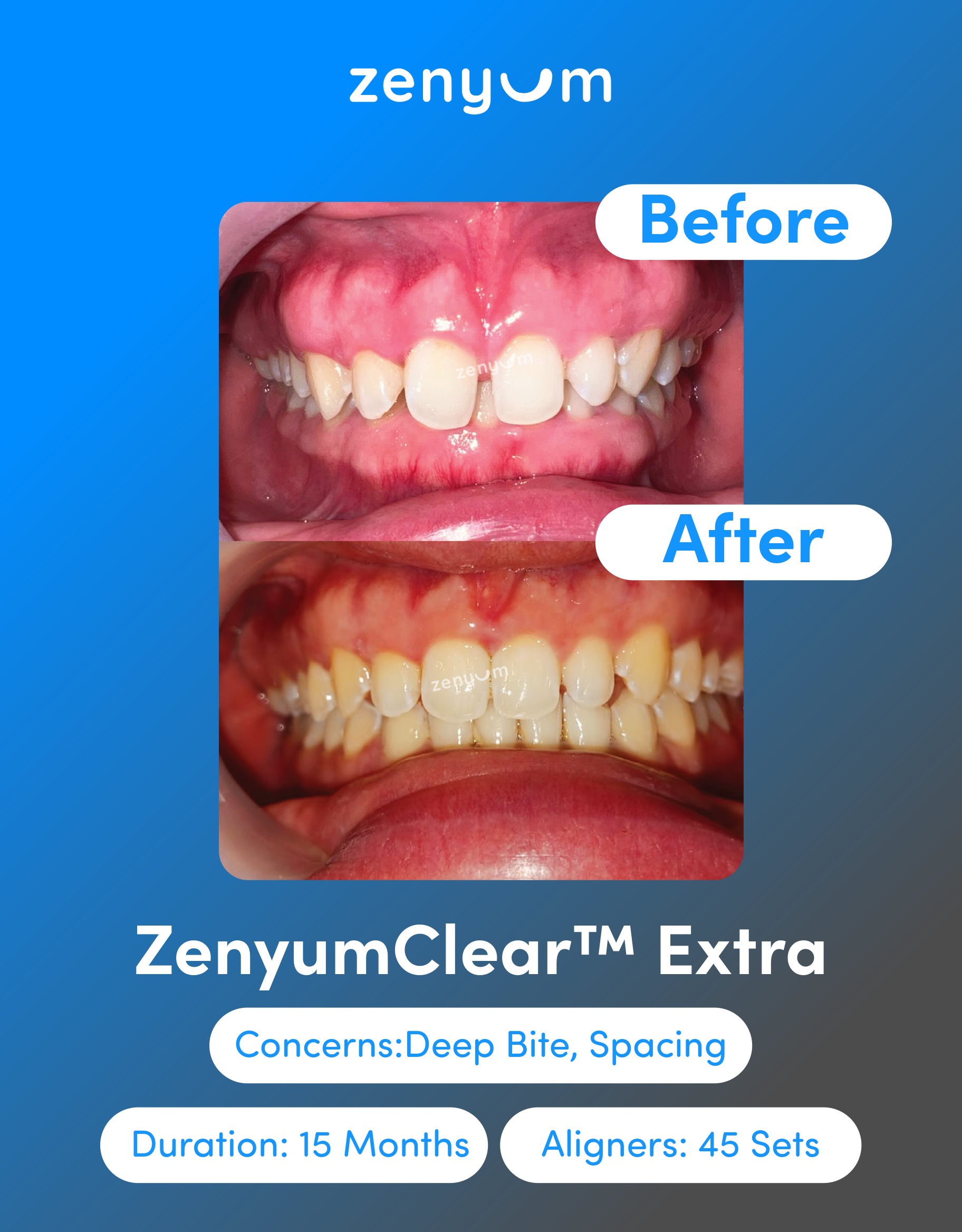
Overbite Before and After: Correcting a Severe Deep Bite & Spacing
Clinical Presentation: Severe vertical deep bite accompanied by widespread maxillary and mandibular spacing.
Treatment Apparatus: ZenyumClear™ Extra
Total Duration: 15 Months
Total Aligner Velocity: 45 Sets of Custom Aligners
Clinical Outcome: Complete closure of dental spacing and restoration of a healthy vertical overlap (normal bite alignment), resulting in optimized facial symmetry and enhanced masticatory (chewing) function.
Overbite before and after with Zenyum Invisible Braces
Braces are still one of the most effective ways to correct a severe overbite especially when the teeth need to move a lot or the bite is deeply off.
Traditional braces: Best for complex cases, they give orthodontists full control over how teeth shift. Great if you are dealing with a severe overbite or crowding.
Invisible (ceramic or lingual) braces: These offer a more subtle look while still delivering strong results. A good middle ground for adults who want something more discreet.
If you're wondering how long do braces take to fix an overbite, the answer usually depends on the case. But for moderate to severe overbites, it typically ranges from 12 to 30 months.
Surgery (For Skeletal Overbites)
In rare cases where the overbite is caused by jaw bone structure, braces or aligners might not be enough. This is when orthognathic surgery may be recommended, often paired with braces or aligners before and after. This is usually reserved for severe skeletal cases where the jaw itself needs to be repositioned to correct the bite and balance the face. While it is more intensive, it can offer dramatic, life-changing results for people with serious misalignment.
Can You Get Rid of an Overbite Naturally?
People often ask, “how to get rid of an overbite naturally?” And while that would be ideal, the truth is: natural methods only help in very mild cases, and only if caught early.
For Children:
In kids, early habits can play a big role. Simple changes like encouraging nasal breathing, correcting tongue posture, or stopping thumb sucking early on can help prevent bite problems from developing.
For Adults:
Some gentle approaches like myofunctional therapy (which retrains the tongue and facial muscles) may help support treatment, but they are not a standalone fix for moderate or severe overbites. So while good oral habits are always helpful, most overbites do not go away on their own. If you notice signs like teeth overlap, jaw discomfort, or trouble chewing, it is important to see a dentist or orthodontist to understand your options.
What’s the Best Way to Treat an Overbite From a Dentist’s View?
Through our chat withDr. Mike, he explained that treatment options can range from clear aligners and traditional braces to jaw surgery for more severe skeletal cases.
“In my practice,” Dr. Mike shared, “clear aligners often strike the best balance. They are discreet, hygienic, and effective. But the right choice always depends on each patient’s diagnosis and goals.”
Let’s break it down: how long do braces take to fix an overbite? The answer depends on a few key things like how severe the overbite is, how old you are, and what kind of treatment you go with.
Average Treatment Time
Here is a general idea of how long treatment usually takes:
Overbite Severity
Average Treatment Time
Mild
6–12 months
Moderate
12–18 months
Severe
18–30+ months
The earlier you start, the faster and easier the treatment tends to be. Teens often respond quicker to braces since their jaws are still developing. For adults, especially with a severe overbite, treatment might take a bit longer. But the results are absolutely worth it.
Not all overbites need the same approach. Here is how different treatment types compare:
ZenyumClear (Mild Cases)
Treatment time: Around 6 to 9 months
Great for: Aesthetic alignment and light overbite correction
Why it works: Moves teeth gently over time with almost invisible trays
ZenyumClear Plus (Mild to Moderate Cases)
Treatment time: 9 to 15 months
Great for: Overbite teeth that need more control and bite correction
Why it works: Uses attachments and remote monitoring for more precise movements
ZenyumClear™ Extra (Mild to Moderate, More Complex Cases)
Treatment time: Around 15 months
Great for: Full-mouth movement, including cases that may need extractions
Why it works: Involves movement of all teeth, attachments on most teeth, and extraction planning when necessary. Designed for patients who need more comprehensive correction but still want the convenience and clarity of aligners.
Traditional Braces (Moderate to Severe Overbite)
Treatment time: 18 to 30+ months
Great for: Complex overbites or major jaw alignment
Why it works: Brackets and wires allow full control over each tooth’s movement
Invisible Braces (e.g., ceramic or lingual)
Treatment time: Usually similar to traditional braces
Great for: Adults or teens who want a less visible option for a braces for severe overbite case
Why it works: Same strength and control, but with a more discreet look
So, how long do braces take to fix an overbite? It all comes down to your smile's unique story. Whether you need a little fine-tuning or a bigger realignment, there is a solution that can fit your lifestyle, and we are here to help you find it.
If you have heard your dentist mention a “Class 2 bite” or “Class 2 overbite,” you might be wondering what it really means, and if it is something you should worry about. Let’s break it down in a way that is simple, practical, and helpful.
What Does a Class 2 Bite Look Like?
A Class 2 overbite happens when the upper teeth and jaw sit too far forward compared to the lower teeth and jaw. From the side, it may look like the top teeth are “jutting out,” while the lower jaw seems tucked back or small. People with Class 2 bites often have:
A deep overbite where the top front teeth cover most of the lower teeth
A smaller or receding chin
A softer, less defined jawline in profile
Trouble fully closing the lips without effort
This type of bite is usually more noticeable in profile photos or side views, and can affect both how your face looks and how your bite functions.
What Causes Class 2 Bites?
Wondering what causes an overbite like this? It usually comes down to a mix of genetics and early habits. Common causes include:
Jaw growth imbalance: The upper jaw grows faster or the lower jaw develops more slowly
Genetics: A Class 2 bite can run in families and often starts in childhood
Prolonged thumb sucking or pacifier use: These habits can shift the position of teeth and affect how the jaw grows
Mouth breathing or tongue posture issues: These can also influence how the jaws form over time
How Do You Treat a Class 2 Overbite?
The good news is that a Class 2 overbite can be treated, and there are a few different ways to go about it depending on your age and how severe the bite is.
For teens and adults:
Braces: Traditional braces are the go-to for Class 2 overbite correction, especially if tooth and jaw movement are both needed.
Clear aligners (like ZenyumClear Plus): Can help with mild-to-moderate Class 2 bites where the problem is mostly dental (not skeletal).
Elastics: Often used with braces or aligners to help guide the jaw into better alignment.
Jaw surgery: For severe cases caused by jaw structure, surgery may be needed to reposition the jaw.
How Long Does It Take to Fix a Class 2 Bite?
Mild cases: Around 12–18 months with aligners or braces
Moderate cases:18–24 months, possibly with elastics or attachments
Severe skeletal cases: May require 24–36+ months, including surgery and post-op orthodontics
Your orthodontist or dental provider will create a personalized plan, depending on how your jaw and teeth are aligned and how much correction is needed. A Class 2 overbite is not bad in every case, but if it is affecting how you eat, speak, or feel about your appearance, it is definitely worth looking into. The earlier you catch it, the easier (and usually faster) it is to fix.
If you have made it this far, you are probably thinking: “Okay… I might have an overbite. Now what?” Here is a simple plan to get started, no pressure, no complicated steps:
Step 1: Take Zenyum’s Free Smile Check
Snap a few photos, send them in, and let our system check if ZenyumClear™, ZenyumClear™ Plus, or ZenyumClear™ Extra might be a fit for your case. It is 100% free, and only takes a few minutes.
If you are a match, we will connect you with one of our trusted partner dentists. They will examine your teeth and bite, confirm your suitability, and answer any questions you have about your overbite or treatment options.
Step 3: Get Your Personalised Treatment Plan
Your journey is unique, so your treatment should be too. If approved, you will receive a personalised Zenyum plan, complete with your expected results, timeline, and pricing. All explained clearly, with support every step of the way. No guesswork. No stress. Just one step closer to the confident smile you deserve.
FAQs About Overbite
1. Will an overbite get worse with age?
Yes, it can. Overbites may deepen over time if untreated. Tooth wear, jaw stress, and habits like grinding can make the bite more uncomfortable. Early treatment helps prevent complications.
2. Can you correct an overbite as an adult?
Absolutely. Adults commonly correct overbites with aligners, braces, or—when needed—surgery. Treatment may take slightly longer than in teens, but it’s very doable.
3. Can an overbite be fixed on its own?
Not typically. While a few mild cases in children may self-correct, most overbites—especially in teens and adults—require treatment to improve or resolve.
4. What happens if you never fix an overbite?
It could lead to jaw pain, uneven tooth wear, headaches, chewing issues, or speech changes. In some cases, facial balance can be affected. Treatment reduces these risks.
5. Is it ever too late to fix an overbite?
No. People start successful treatment in their 30s, 40s, 50s, and beyond. Younger patients may finish faster, but it’s never “too late.”
6. Is it unhealthy to have an overbite?
A minor overbite is normal. A deep or symptomatic overbite can affect oral health and quality of life. In those cases, correction is recommended.
7. Does fixing an overbite change face shape?
It can—especially in moderate to severe cases. Correction often improves jawline definition, facial balance, and profile while keeping your natural look.
8. Can I still be attractive with an overbite?
Of course. Many people with overbites are attractive. If it affects your confidence or comfort, treatment may help—but attractiveness isn’t defined by one feature.
9. Does an overbite cause chubby cheeks?
Not directly. A deep overbite can shorten the lower face or retrude the chin, which may make cheeks appear fuller. Correction can sometimes refine facial contours.
10. Will fixing my overbite change my lips?
Often yes, in subtle ways. Many notice lips sit and close more naturally after treatment; a protruding upper lip can appear less pronounced.
11. How to tell if your overbite is getting worse?
Upper teeth cover more of the lower teeth
Jaw pain or clicking increases
Teeth feel more worn
Lip or chin posture feels different
If you notice these, check in with a dentist.
12. Does fixing an overbite change your voice?
It can, if the overbite affects tongue movement or certain sounds. Some people find speech becomes clearer or more comfortable after correction; changes are usually subtle.
13. Is it harder to speak with an overbite?
Sometimes. A pronounced overbite can interfere with sounds like “s,” “z,” or “sh,” and may contribute to a slight lisp. This varies by person.
14. Will fixing an overbite change your nose?
Your nose doesn’t change, but overall profile and facial balance may. After correction, facial proportions can make the nose look different in relation to the face.