
A perfect smile is about more than straight teeth. How much of your teeth shows, the curve of your smile, and the balance between your teeth, gums and lips all contribute to its appearance.
You might have fairly straight teeth but still wonder why your smile looks uneven or why your upper teeth barely show. Understanding what influences your smile can help you explore suitable options, whether that involves braces, clear aligners or other dental care.
In this guide, Zenyum explains the features of a balanced smile, common concerns and when teeth straightening may help.
There is no single definition of a perfect smile. Dentists consider proportions and symmetry when assessing smile aesthetics, but these are guides rather than rules everyone needs to meet.
Your facial features, lips, natural tooth shape and preferences all matter. The following four features can help you understand how these elements work together.
The way your teeth sit next to one another influences the overall balance of your smile. Dentists may consider crowding, spacing, tooth size, symmetry and the position of your dental midline—the line between your two central front teeth.
You may have heard of the dental “golden proportion”. This describes a proposed relationship between the visible widths of neighbouring front teeth, rather than a universal width-to-height ratio for every tooth. Research does not support one mathematical formula as the standard for an attractive smile.
If your concern is crooked teeth or gaps, braces or clear aligners may help by changing tooth positions. Differences in tooth shape or colour may require a separate approach.
The number of visible upper teeth affects how broad or full a smile appears. However, there is no fixed number you need to show for your smile to look attractive.
Tooth display depends on several factors, including the width of your mouth, your dental arch and the position of your teeth. A relaxed smile will also look different from a broad smile or laugh.
Rather than counting visible teeth, a dental assessment considers how your teeth appear within the overall frame of your lips and face.
Your smile arc is the curve formed by the biting edges of your upper front teeth in relation to your lower lip when you smile.
An upper tooth curve that follows the contour of the lower lip is often described as a consonant smile arc. A flatter or uneven curve creates a different appearance, even when the teeth themselves are straight.
There is no need to aim for a fixed percentage of upper and lower tooth display. A dentist can assess whether tooth positions contribute to the features you would like to change.
Gum display affects the balance between your teeth and lips. Both a small amount of visible gum and a smile with little or no gum showing can look natural.
Research has found that no single amount of gum display is universally considered attractive. Personal preferences vary, so a measurement alone cannot determine whether your smile needs changing.
If you feel that too much gum shows when you smile, the next step is to understand why. Tooth position, gum coverage, lip movement and jaw structure can all play a part.
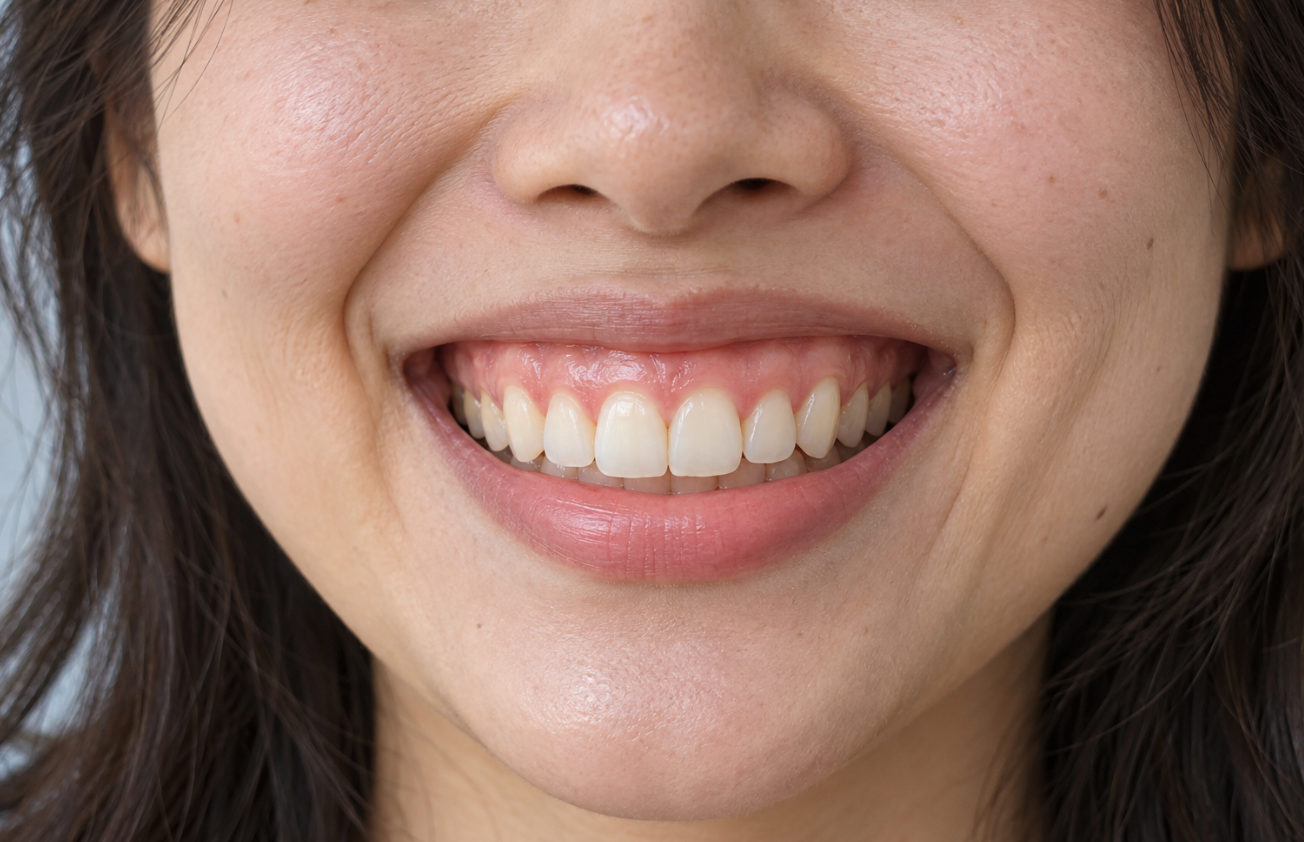
Feeling unhappy with your smile does not necessarily mean something is wrong with your teeth. Sometimes, the concern involves how your teeth, gums and lips appear together.
Crowding, rotated teeth, protruding teeth and noticeable gaps can affect the appearance of alignment. Differences in the size or shape of your front teeth may also make your smile look less symmetrical.
Colour is a separate consideration. Yellowing, stains or one tooth appearing darker than its neighbours can draw attention even when the teeth are straight.
The appropriate approach depends on the cause. Teeth straightening changes tooth positions; it does not directly whiten teeth or repair a chipped edge.
If your upper teeth barely show, you may feel that your smile looks smaller or less expressive. However, limited tooth display does not automatically mean you need braces.
Possible contributing factors include:
A dentist can assess these factors together. Looking at a selfie alone cannot reliably establish the cause.
A gummy smile describes a smile in which a noticeable amount of upper gum is visible. Whether this bothers you is personal; visible gums are not automatically a problem.
A gummy smile may involve gum coverage, tooth position, upper-lip movement or the vertical proportions of the upper jaw. More than one factor may contribute.
This is why braces or clear aligners are not the answer for every gummy smile. The options depend on the underlying cause.
The spaces between your outer upper teeth and the corners of your mouth are called buccal corridors. These shadowed areas are a normal part of a smile.
More noticeable spaces can make a smile appear narrower, but they do not prove that your dental arch is too narrow. Lip shape, tooth positions and the way you smile also influence their appearance.
If you also have crowding or bite concerns, a dentist can assess whether adjusting tooth positions would be appropriate.
If you are searching for how to get perfect teeth, start by identifying what you would actually like to change. Different concerns need different approaches.
These concerns involve tooth positions and sometimes the way your teeth bite together. Braces or clear aligners may be options, depending on your teeth, gums, supporting bone and the movements required. An assessment can help distinguish a mainly dental concern from one involving jaw structure.
If colour is your main concern, straightening your teeth alone will not address it. A dentist can assess the cause of discolouration and discuss whether cleaning, whitening or another approach is suitable. Different types of staining respond differently, so the same whitening option will not suit every situation.
Chipped edges, differences in tooth size or uneven shapes can affect the outline of your smile. Moving teeth may improve how they sit together, but it does not change their underlying shape. A dentist can explain whether restorative options are relevant, either on their own or alongside teeth straightening.
These concerns may involve several structures at once. The key question is whether the appearance comes mainly from tooth positions, gum coverage, the lips or the jaws. Understanding the cause helps you set realistic expectations before choosing an option.
Practising a smile may help you feel more comfortable with your expression, particularly in photographs. However, it should not be presented as a proven way to straighten teeth, change jaw structure or correct a gummy smile.
It is helpful to separate practising an expression from changing the dental features behind it.
For a relaxed practice, try looking in a mirror, releasing tension in your jaw and gently smiling without forcing your lips apart.
Keep the movement comfortable. You do not need to use bite sticks, pull your lips upwards or hold a strained expression. Stop if practising causes discomfort.
Think of this as becoming familiar with your natural smile, rather than a routine that promises a particular amount of tooth or gum display.
Braces may improve smile balance when the concern involves tooth alignment or bite. They cannot guarantee a perfect smile or address every issue involving tooth colour, shape, gums or lips.
Braces can move crowded, rotated or spaced teeth towards planned positions. Where appropriate, they can also help address a dental midline that is off-centre.
The aim is to improve alignment within the limits of your oral health and supporting structures. How far a midline can change depends on the cause of the discrepancy.
Protruding front teeth, a deep bite and other bite concerns can affect how teeth appear when you smile. Orthodontic planning may address some of these features. However, a concern caused mainly by tooth positions can require a different approach from one involving the size or position of the jaws.
Your dentist can explain which changes are realistic for your case.
Changes to tooth positions may influence the smile arc and the amount of teeth visible across your smile. In suitable cases, adjusting dental arch alignment can also change the appearance of the spaces at the sides. However, making an arch wider is not automatically better. Planning needs to account for bone support, gum health and how the teeth fit together.
Clear aligners may be suitable for concerns such as crowded teeth, gaps, crooked teeth and certain bite issues. They use a sequence of removable trays to move teeth gradually towards planned positions.
Suitability depends on the specific movements required and your oral health. Some complex movements are less predictable with aligners, and some cases require additional appliances or a different approach.
Clear aligners do not directly whiten teeth, reshape chipped teeth or resolve every cause of limited tooth display or a gummy smile.
In Singapore, Zenyum offers ZenyumClear™, ZenyumClear™ Plus, ZenyumClear™ Extra and ZenyumClear™ Ultra. A partner dentist recommends an appropriate option following an in-clinic assessment. Choosing a plan involves more than matching your smile to a photograph or selecting a preferred price.
You can explore Zenyum clear aligner options to learn more about the available plans.
A smile you feel comfortable sharing does not need to meet a fixed set of proportions. The most useful starting point is understanding what you would like to change and what is causing it.
If your concern involves crowding, gaps or tooth positions, braces or clear aligners may help. If it mainly involves colour, tooth shape, gums or lips, a different approach may be more suitable.
Interested in exploring Zenyum? Start your free online Smile Check as an initial step. An in-person dental assessment is still needed to determine suitability, and clinic consultation, scan and other applicable fees are separate. Confirm what your proposed plan includes before proceeding.

Answer a few questions, and take four teeth pictures. It only takes a few minutes!

Receive a call from us to schedule your dentist appointment

You’ll have 3D scans and X-rays taken of your teeth by your dentist

Give the green light for your Zenyum aligners to go into production after approved by your dentist.


